Two places an answer comes from
An assistant has two things to draw on when it answers a question about products or services.
- What the model already knows. It was trained on a large amount of text up to some date. If your category was written about a lot, and your brand was part of that writing, the model associates you with the category before it looks anything up.
- What it finds now. With web search on, the assistant looks things up while it answers and builds the reply from the pages it reads. This is how it gets prices, recent launches and comparisons that are newer than its training.
For buying questions, both matter, and you cannot see the first one directly. What you can see is the second: the pages an assistant cited and, for most assistants, the searches it ran. That is also the part that changes week to week, so it is where most of the explaining happens when an answer moves.
From the question to the answer, step by step
The exact process differs between products and is not published in full. The general shape of a search-grounded answer is the same, though, and it has four steps.
- The assistant rewrites the question as searches. A buyer writes a paragraph. The assistant turns it into one or more short queries of its own. A question about “a software partner for a mid-sized logistics company that needs a new customer portal” may become searches like
logistics customer portal development companies. The buyer never sees these queries. - The search returns a list of pages. Which pages come back depends on the search the assistant uses, the country the question is asked from, and the day. It is not your Google ranking for the buyer’s words. It is a ranking for the assistant’s words.
- The assistant reads a few of them. It does not read everything. It picks pages that look like they answer the question, and takes facts, lists and opinions from them.
- It writes the answer and attaches sources. The answer combines what it read with what it already knew. Some of the pages it used are shown as citations. Others shaped the answer and are not shown.
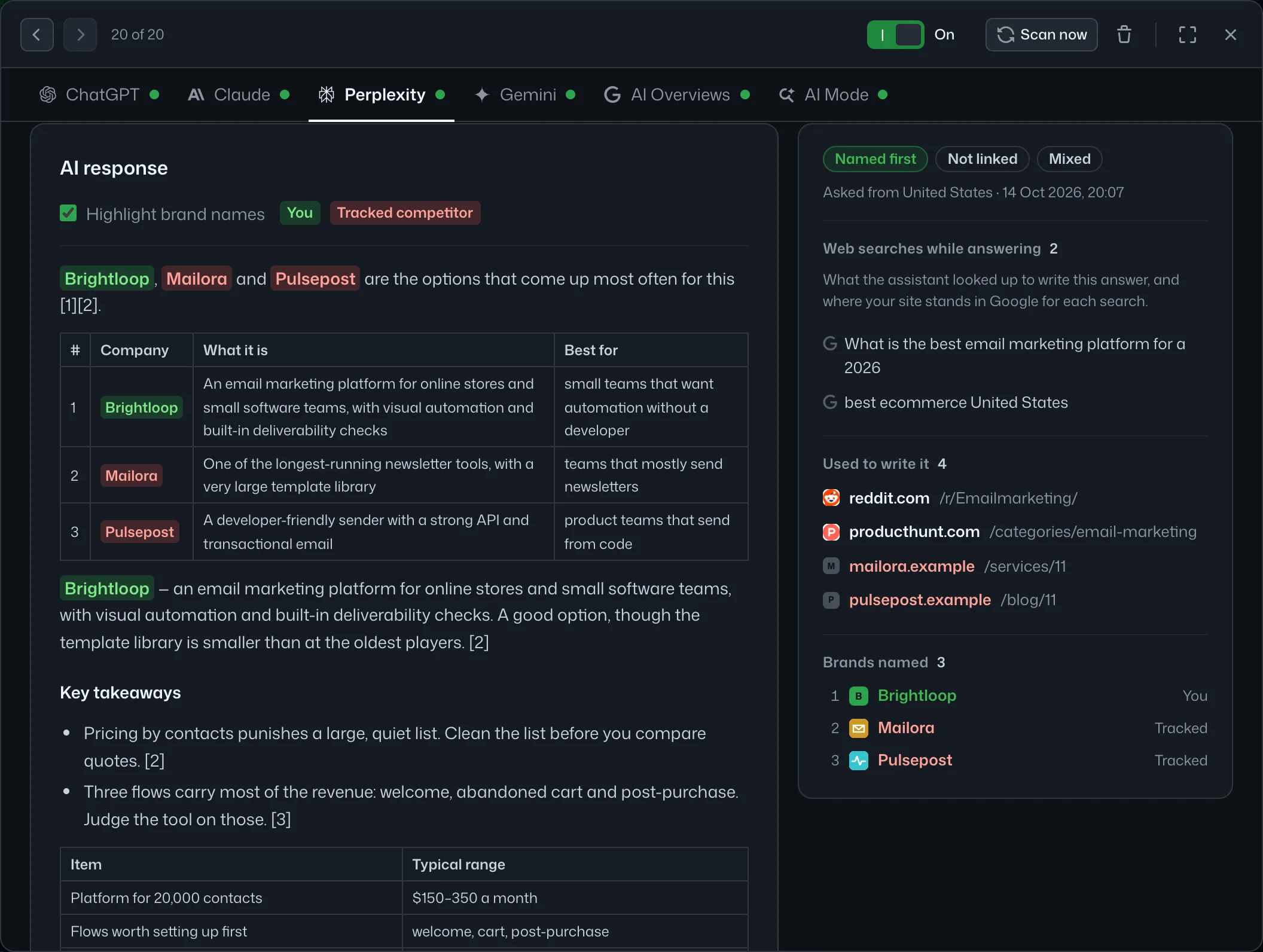
Teddit keeps the evidence of steps 1 and 4 for every answer: the searches the assistant ran, for the assistants that disclose them (ChatGPT, Claude, Perplexity and Gemini), and the pages it cited. For each of those searches it also checks Google’s top results in your site’s country, so you can see where your own pages stand for the words the assistant actually used.
Who gets named
A brand ends up in the text of an answer for a small number of reasons. None of them is a secret ranking factor. They follow from the steps above.
- It is in the pages the assistant read. If the assistant reads a round-up of “the best logistics software partners” and you are on that list, you are a candidate. If the round-up lists six firms and you are not one of them, you rarely appear, whatever your own site says.
- The model already links you with the category. A brand that has been written about for years in a category tends to be named even when the pages found that day do not mention it. A newer or smaller brand has to be found.
- Your pages match the specifics of the question. The more precise the buyer is (an industry, a size, a problem), the more an answer depends on pages that describe exactly that. A detailed case study can carry a smaller firm into an answer for a narrow question that a large firm wins on broad ones.
We saw the third point clearly in nine weeks of data from a software services company. Its name came up in about 3% of answers overall, but some very specific “can you recommend a vendor for…” questions named it in most weeks. The details are in the case study.
Which pages get cited
Citations follow the reading step, not the naming step. A page is cited when the assistant found it and used something from it. That gives a few patterns worth knowing.
- Most citations go to other people’s pages. Encyclopedias, research, analyst and consultancy reports, vendor documentation, trade press, forums, review sites and other companies’ blogs. In the case study above, 98% of the cited sources were neither the company’s site nor a tracked competitor’s.
- Explanatory pages get cited for explanatory questions. A clear guide or article is a natural source for a “how does this work” question. That does not mean the assistant will recommend the company that wrote it.
- Assistants differ in how many sources they show. Some attach a handful of links to an answer, some attach twenty. A long source list makes it more likely that your page appears somewhere in it, and less likely that it mattered much.
What is in your hands
Seen this way, the work is less mysterious than it is sometimes made to sound. Some general lines of thinking follow from the process, and none of them is specific to AI.
- Be readable. An assistant can only use a page its crawler and its search can reach. Check that your robots.txt does not close your site to the crawlers that feed assistant search. Teddit shows this per crawler on the Pages screen; see AI crawler access.
- Say plainly what you do, for whom. Pages that state the industry, the problem and the result in concrete words are easier to match to a specific question than pages written in general terms.
- Be present where the lists are written. If the answers for your category keep citing the same round-ups, directories or comparison articles, being included there is often the shortest way into the answer.
- Look at the assistant’s searches, not only the buyer’s question. The queries an assistant runs tell you which pages it was looking for. Your Google position for those queries tells you whether you were in the pile it chose from.
Teddit does not tell you which of these to do. It shows the answers, the sources and the searches, per prompt and per assistant, and leaves the judgement to you and to your own AI. Before acting on any single answer, read One scan is a sample: the same question asked next week can come back different for reasons that have nothing to do with you.