Why clients are asking now
Buyers increasingly get a written answer before they see a list of links. Pew Research Center looked at the browsing of 900 US adults in March 2025: about one Google search in five showed an AI summary, and when it did, people clicked a traditional result in 8% of visits, against 15% when there was no summary. A link inside the summary itself was clicked in 1% of visits (Pew Research Center).
So the question a client asks is no longer only “where do we rank?” but “when a buyer asks an assistant, are we in the answer, and who is named instead?”. The tools an agency already reports from do not answer it. Google counts traffic from AI Overviews and AI Mode inside the ordinary Web search figures in Search Console (Google Search Central), and ChatGPT, Claude, Perplexity and Gemini have no console for brands at all.
What to put in scope
A workable service has four parts, each agreed with the client before the first scan.
- The questions. 20 to 40 questions per client, written the way a buyer asks an assistant, without the client’s name in them: “Which agencies in Berlin build Shopify stores for fashion brands?”, not “Is Acme good?”. Cover the client’s main services and the buying stages. How to choose the prompts worth tracking goes through it.
- The assistants. The ones the client’s buyers use. For most B2B clients that is ChatGPT, Google’s AI Overviews and AI Mode, Gemini, Perplexity and Claude. The cheapest option of each costs between about half a cent and two and a half cents per answer, so one more assistant changes the bill little.
- The competitors. Three to eight brands the client actually loses deals to, so the report can say who is named instead.
- The cadence. Weekly. Answers vary from one asking to the next, so a single scan is a sample, and a month of weekly scans is what a trend can be read from (One scan is a sample). For a client where every point matters, ask each question three times per scan.
What to report every month
Clients read a short report with the same figures every month. These are the ones that hold up:
| Figure | What it tells the client |
|---|---|
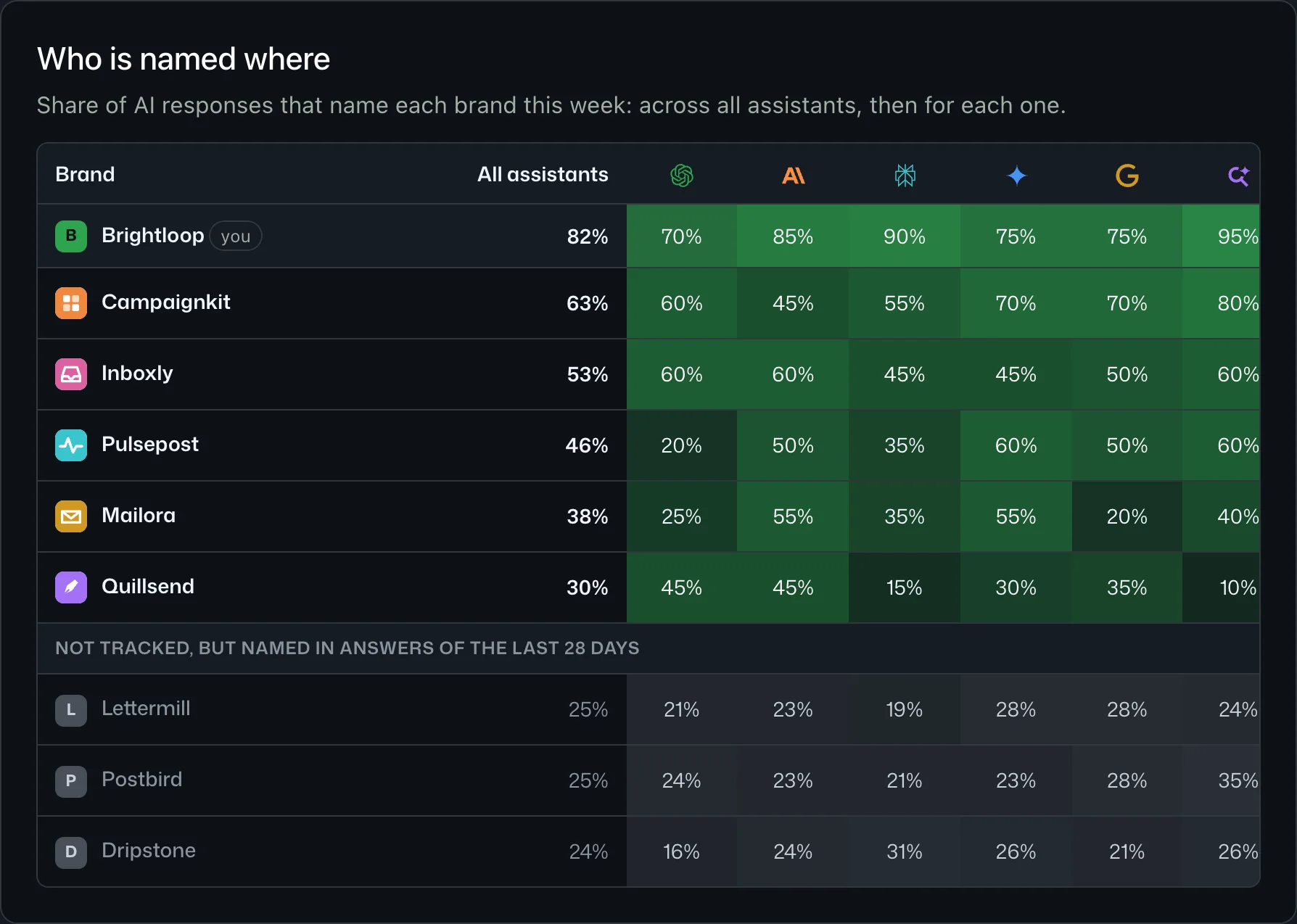
| Named | The share of answers that name the client at all. The headline number. |
| Named first | How often the client is the first brand an answer recommends. Being in a list of eight is not the same as leading it. |
| Linked | How often an answer links to the client’s own site. It is often higher than Named: assistants read and cite pages of brands they do not recommend. |
| Share of voice | The client’s share of all brand mentions against the tracked competitors. The figure a sales director understands without explanation. |
| Pages cited | Which of the client’s pages, and which third-party pages, the assistants read for these questions. This is where the next month’s work comes from. |
| What changed | Questions where an assistant started or stopped naming the client since the last report, with the answer itself. |
Expect small numbers at the start. In our nine-week case study of a software company, it was named in about 3 answers in 100 across its whole question set, and linked more often than named. A starting point like that is a reason to sell the work, not a failure to hide.
What not to promise
- No position guarantees. The same question gets different answers from one asking to the next, and the vendors change their models and search without notice. Promise measurement and work on the causes, not a place in an answer.
- No tricks for the model. Google says there are no additional requirements and no special optimizations needed to appear in AI Overviews or AI Mode, and no special structured data to add (Google Search Central). What helps is what helps a careful reader: pages that answer the question, and other sites that mention the client.
- No reading of one week. A drop from one scan to the next is usually noise. Report a change once it has lasted two or three scans.
What the agency can actually work on
The report should end in work the client pays for. Four kinds of work follow directly from what the tracking shows:
- Access. Make sure the assistants’ search crawlers are allowed in robots.txt. OpenAI recommends allowing OAI-SearchBot to appear in ChatGPT’s search results (OpenAI), and Perplexity recommends the same for PerplexityBot (Perplexity). It is a quick fix that is still missed: in our check of 23,411 business websites, 2.5% were closed to ChatGPT’s search, most of them without having decided to be.
- Pages that answer the tracked questions. When the assistants cite a competitor’s comparison page or a third-party guide for a question where the client is absent, that page shows what the client’s site is missing.
- Mentions on the sites the assistants read. The cited third-party pages, such as industry directories, review sites and articles, are the outreach list.
- Consistent naming. If the client’s brand is written three ways across its site and its profiles, answers will spell it three ways too, and some of them will not count as the client.
What the tracking costs per client
With Teddit there is no subscription: a scan is paid per answer from a prepaid balance. For one client with 30 questions, asked weekly in the queue (scheduled scans wait in the queue and cost less than scans run at once), the answers cost about this much a month at today’s prices:
| Setup, 30 questions weekly | Per scan | Per month |
|---|---|---|
| All six assistants, the cheapest option of each, one answer per question | $1.91 | about $8 |
| The same, three answers per question | $5.43 | about $24 |
| All six, each assistant’s standard model, one answer per question | $17.59 | about $76 |
These are the answers only; the estimate shown before every scan adds the small extras, such as the tone of voice and the Google rank checks, and a month has 4.33 weekly scans. Prices change with the vendors’ prices; the current ones are on the pricing page. For most agencies the tracking is a small line next to the hours spent reading it and doing the work it points to, and that work is what the retainer is for.
Setting it up for several clients
- One site per client, each with its own questions, competitors, schedule and monthly cap, inside one agency workspace with one balance. Or a workspace per client when the client pays for its own scans.
- Clients as viewers. A client can be invited with read-only access to its own site only, or receive a report link that opens without signing in, signed with the agency’s name and logo.
- The analysis in the agency’s own AI. Through the MCP server, Claude or ChatGPT reads every answer and citation and can draft the monthly commentary, so the account manager edits rather than writes.
The agencies page shows the layout, and the first scan of a new client can run the same day.
Sources
- Google users are less likely to click on links when an AI summary appears in the results, Pew Research Center, July 2025.
- AI features and your website, Google Search Central.
- Overview of OpenAI crawlers, OpenAI: OAI-SearchBot.
- Perplexity crawlers, Perplexity: PerplexityBot.