Three facts about every answer
When an assistant answers a buyer’s question, three separate things can happen to your brand.
- Named. Your brand appears in the text of the answer.
- Named first. Of the brands the answer names, counting you and the competitors you track, yours comes first.
- Linked. The answer links to a page on your site, as a cited source or as a URL in the text.
These do not move together. An assistant can recommend you and send the reader to a review site. It can also quote your guide as a source and recommend somebody else. So Teddit records each fact on its own for every answer it stores, and the square you see is the combination.
The six states of a square
One square is one assistant’s answer to one prompt in one week. It is always in one of six states.
| State | What the answer did |
|---|---|
| Named first + linked | Named you before any competitor you track, and linked to your site. |
| Named + linked | Named you, though not first, and linked to your site. |
| Named or linked | One without the other: your name with no link to you, or a link to your page in an answer that never names you. |
| Not named | Neither named nor linked you, and named none of your tracked competitors either. |
| Competitors only | Neither named nor linked you, but named at least one competitor you track. |
| Not scanned | There is no answer yet: the assistant has not answered this prompt, or its latest attempt failed. |
Not named and competitors only look alike from your side, since you are absent in both. They are different problems. In the first, the assistant answered without bringing up any brand you track, which often happens with how-to questions. In the second, it did recommend brands in your space and left you out.
Not scanned is not a zero. A missing answer says nothing about your visibility, so it stays out of every rate Teddit calculates.
Why the list shows states and not one blended score
It is tempting to turn all of this into a single number and watch it go up. We lead with the squares for three reasons.
A blended score hides a choice. To blend, someone has to decide how much a link is worth next to a mention, and how much first place is worth next to third. Those weights are opinions. Once they are inside a number, you can no longer see them or disagree with them.
A blended score hides what moved. Say a score falls from 62 to 58. You may have lost a link on one assistant. You may have slipped from first to third on several. You may have vanished from one prompt altogether. Those are three different jobs, and the number does not say which one you have.
An average hides the prompt that matters. A brand can look steady overall while its most valuable buying question flips to competitors only. In a grid that flip is a change of colour in a known place. In an average it is a rounding error.
A state is also something you can check. Open a prompt and each square leads to the answer behind it, so you can read the text and see why it was classed that way.
Reading a row and reading a column
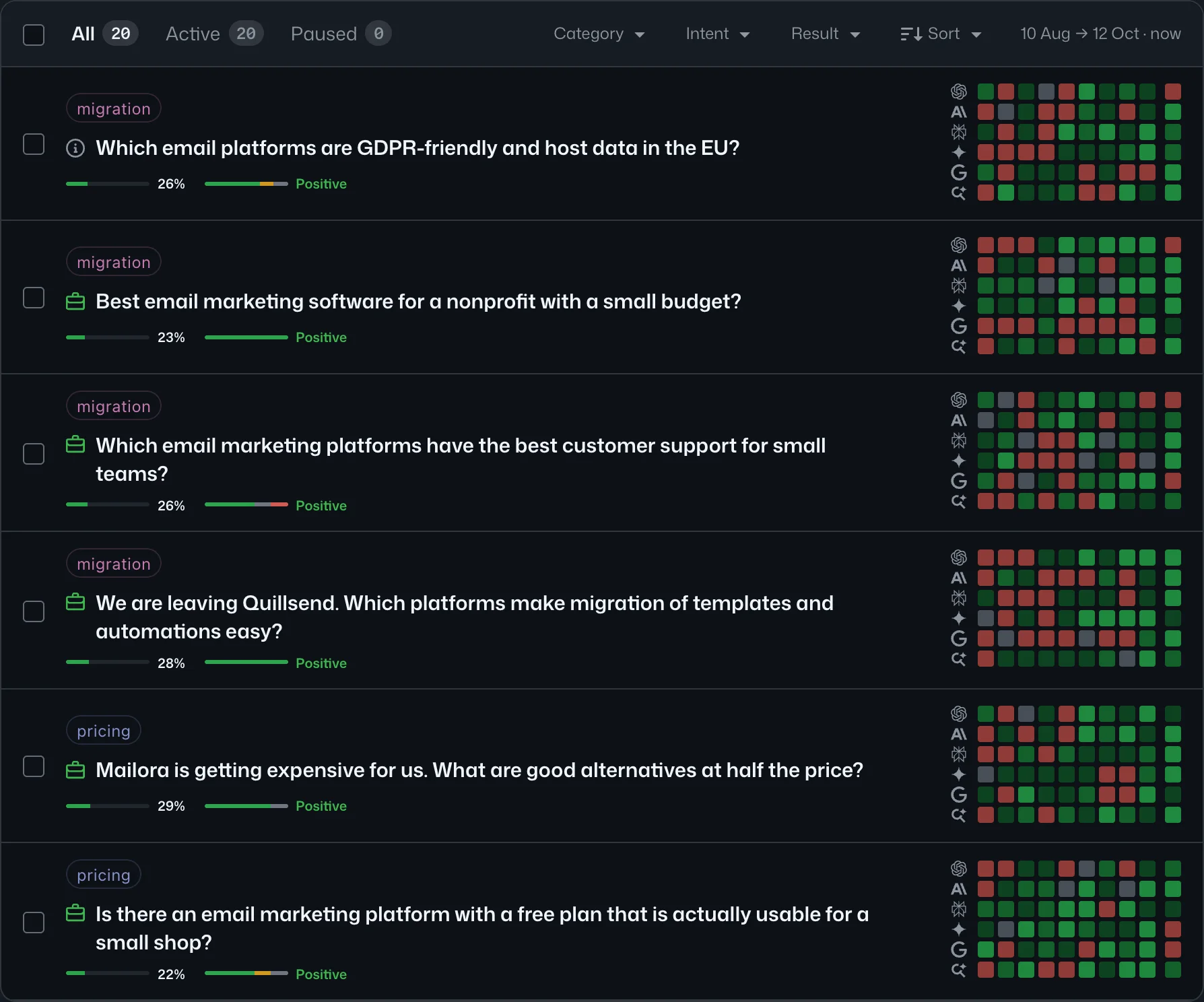
In the prompts list each prompt carries its own small grid: one line per assistant, one square per week, oldest on the left. The last square, set slightly apart, is the latest answer.
Along a row: one assistant over time
Look for runs, not single squares. One answer is one draw, and assistants do not answer the same way every time. A single odd square inside a steady run is usually noise. A run that changes and stays changed is a finding. We wrote about why in Why the same question gets different answers.
Down a column: one week across assistants
If every assistant changes in the same week, look for a cause they share: a page of yours that changed, a new article about your category, or an edit to the prompt itself. If only one assistant changes, the cause is more likely on its side, in its model or in what its web search returned that week.
Say Brightloop, a made-up email marketing platform, tracks the prompt “Which email marketing platform is best for a small online shop?”. For six weeks one assistant’s row reads named + linked. Then it reads competitors only for three weeks, while the other rows stay as they were. One assistant, one prompt, and a change that held. Open the first square after the change and read the answer. If it now names Mailora and Quillsend and cites a comparison article that does not list Brightloop, you know where to look next.